
Why Music Has Always Been One of Humanity’s Most Powerful Cognitive Resources
Music accompanied the moments that shaped human life long before neuroscience explained how the brain changes, predicts, and functions through interconnected neural networks. Wherever we look throughout human history, regardless of continent, culture, or language, music has been part of every human community.
From an evolutionary perspective, such universality is particularly compelling. Behaviours that persist for thousands of years usually contribute to learning, cooperation, adaptation, or survival. A growing body of research suggests that music played exactly this kind of role throughout human evolution. Within fractions of a second, listening to music engages brain systems involved in attention, learning, movement, and memory. Multiple neural networks coordinate their activity and continuously exchange information, making music one of the few everyday experiences that simultaneously engages so many interconnected brain systems.
Music is part of the environment in which our brain processes information, directs attention, regulates internal states, and shapes our experience. Just as natural light influences our circadian rhythms and temperature affects our physiology, sound continuously shapes the conditions in which our brain functions.
More Than What We Hear
Music accompanies us throughout the day, at work, during moments of rest, celebrations, travel, and countless everyday experiences. We choose it when we want more energy, greater focus, comfort, or simply to enjoy the moment. Most of those choices happen spontaneously because a particular piece of music simply feels right at that moment, but we rarely stop to ask why.
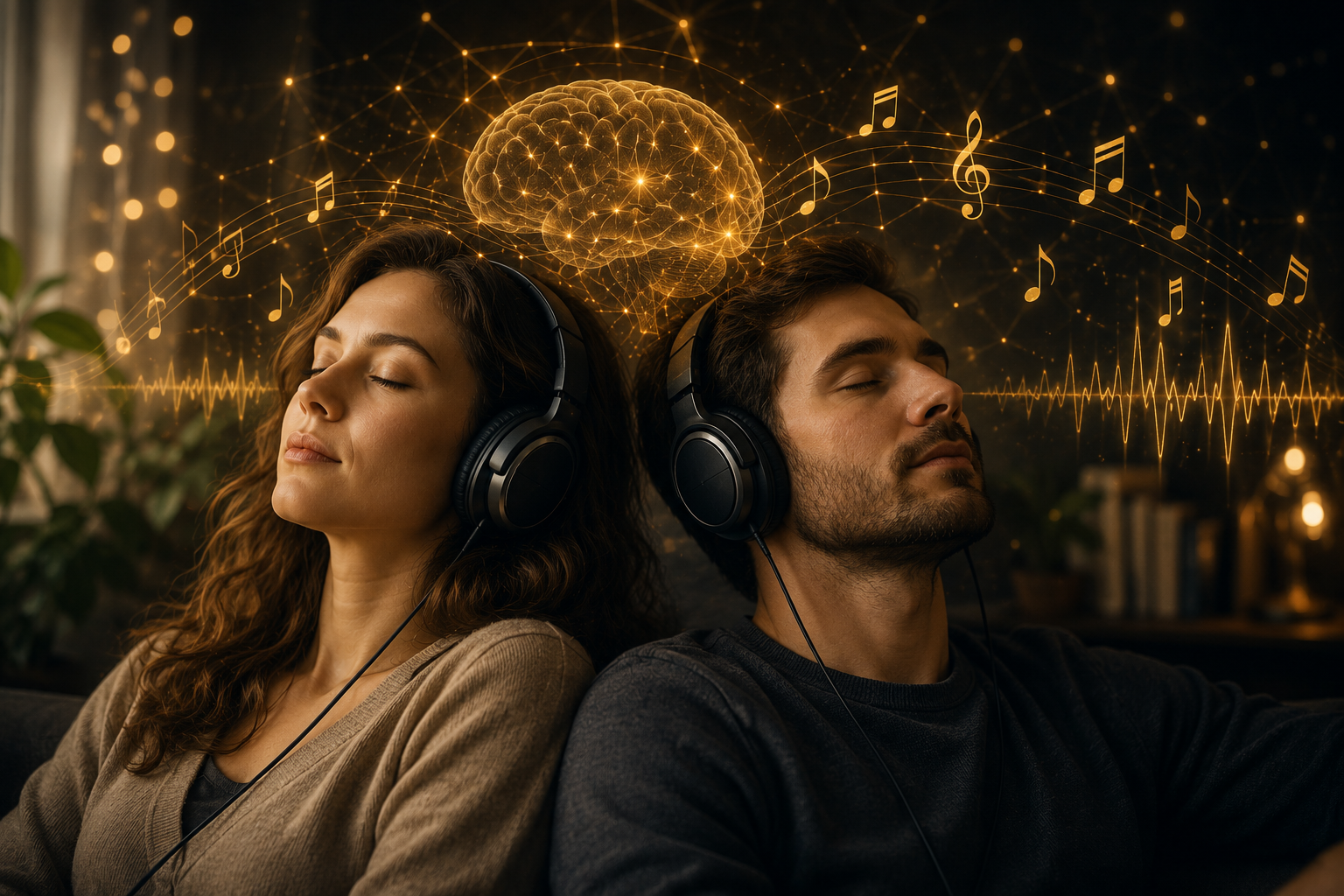
Listening to music involves far more than recognising sounds. Within fractions of a second, the brain analyses pitch, rhythm, harmony, and tempo while memory compares what we hear with patterns built through previous experience. Emotional systems evaluate their significance, motor regions prepare the body to synchronise with the rhythm, and the autonomic nervous system adjusts breathing, heart rate, and many other automatic bodily functions. The music we listen to becomes part of the environment in which the brain processes information, directs attention, regulates internal states, and interprets the world around us.
Active participation in music engages an even broader network of brain systems. Playing an instrument, singing, and dancing simultaneously integrate the auditory system, movement, attention, planning, memory, coordination, and precise motor control. The more senses involved in the experience, the richer and stronger the neural connections the brain builds. Through neuroplasticity, those connections can continue to strengthen and adapt in response to experience. That’s why long-term engagement with music can lead to measurable changes in both the functional and structural organisation of the brain. As a result, musicians and dancers often develop stronger connectivity between specific brain regions, more refined motor control, and a greater capacity for adaptation and learning.
The Music We Listen to Becomes Part of Our Inner Dialogue
Much of the music we listen to every day carries another powerful element: words. They give songs meaning, turn them into stories, and shape how we think about love, relationships, loss, hope, success, and our own identity. To the brain, lyrics are language. It searches for meaning, connects words with previous experiences, and gradually weaves them into the mental patterns we use to make sense of the world. Neuroscience shows that the brain learns through repetition. The more often we’re exposed to certain words, stories, and ways of thinking, the more easily we recognise them, recall them, and draw on them when interpreting new experiences. The same applies to the language that surrounds us every day. That’s why it matters which stories we keep listening to and which words we use to describe love, relationships, life, and ourselves. Language doesn’t just reflect our thoughts, it also becomes part of the way we think.
If the songs we listen to repeatedly portray love as suffering, relationships as betrayal, and change as impossible, those stories can gradually become part of the way we interpret our own experiences. At the same time, music can foster hope, gratitude, courage, trust, and a sense of connection. It can remind us of the values we want to live by and open the door to a different perspective. That’s why it’s worth paying attention to the stories we choose to hear again and again. Over time, the words we hear can become part of our inner dialogue, and that dialogue gradually shapes the way we experience our own lives.
Your Brain Is Built to Recognise Patterns
One of the brain’s most important abilities is recognising patterns, and music provides an ideal environment for that process. As a melody unfolds, the brain is already anticipating the next note. Neuroscientists often describe this process as prediction error. The brain continuously compares what it expects to hear with what actually happens, using even the smallest differences to refine its internal models of the world. Rhythm creates structure, harmony builds expectation, and subtle variations introduce just enough surprise to keep our attention engaged. This balance between predictability and surprise is one of the reasons music remains so compelling. It is also closely linked to the brain’s reward system. When music unfolds in ways that are both familiar and slightly unexpected, it can trigger dopamine release, reinforcing attention, curiosity, and the motivation to keep listening.
If a song were completely predictable, we would quickly lose interest. If every note were entirely unexpected, listening would become mentally exhausting. Music that strikes the right balance between familiarity and surprise holds our attention for longer. Once memories, emotions, and personal meaning become part of the experience, it becomes easier to understand why we return to certain songs again and again. Every new experience, relationship, life lesson, and emotion changes the way we hear the same melody. Over time, our favourite songs become a soundtrack to our lives, preserving different chapters of who we are.
Rhythm Brings People Together
People didn’t need neuroscience to recognise the value of music. They had experienced its effects for thousands of years. Rhythm accompanied some of humanity’s earliest activities. Whenever cooperation, coordination, or stronger social bonds were needed, rhythm was there. The brain naturally synchronises with predictable external rhythms. When people clap, sing, or dance together, their movements gradually become coordinated, attention aligns to the same moments in time, and even breathing can begin to synchronise. A shared rhythm creates a shared sense of timing, allowing a group to function as a coordinated system.
Cooperation begins with synchronisation. Before people can create, build, or solve problems together, they first need to find a shared rhythm, and music offers one of the simplest ways to achieve it without a single spoken word. That’s why singing together creates such powerful bonds between people who’ve never met before. It’s why sports fans instinctively sing the same songs, why children’s games almost always revolve around rhythm, and why every culture has developed music that strengthens a sense of belonging. Over time, music became one of the ways people built communities, strengthened relationships, and created lasting social bonds.
One of Our Oldest Tools for Self-Regulation
When we think about emotional regulation today, breathing exercises and mindfulness are often the first things that come to mind. Both have their place, yet people have used music to regulate their internal state for thousands of years.
We often talk about relaxing or motivational playlists, but perhaps it’s time to introduce another concept: regulatory music. It’s the music we intentionally choose to support a particular mental, emotional, or physiological state. Emotional regulation extends far beyond relaxation or motivation. Sometimes we need more confidence, focus, creativity, or emotional stability. Different kinds of music can support different internal states, making music one of the most adaptable resources we have. Rather than searching for the perfect playlist, it may be more valuable to discover which music most consistently helps us develop the state we need in a particular moment. Listening to music then becomes more than a habit and becomes a conscious way of relating to our own inner world.
The potential of music to support different internal states is also recognised in therapeutic settings. Music therapy is used in stroke rehabilitation, in the care of people living with dementia, and as a valuable support for mental health. Although music isn’t a treatment in itself, it can encourage movement, improve communication, awaken memories, and support emotional regulation.
Designing Our Soundscape
We’re becoming more aware of how the spaces where we live and work affect us every day. That’s why we invest in our workplaces, look for natural light, and surround ourselves with plants. Sound, however, rarely receives the same consideration, even though it’s constantly present. Most of the time, we’re choosing more than just the music we listen to. We’re also choosing the soundscape we spend our day in. It may be filled with traffic, conversations, notifications, silence, or music. Together, these sounds create the soundscape the brain continuously processes, whether we’re consciously aware of it or not.
The next time you listen to music, ask yourself a simple question: What kind of soundscape do I want to create? Sometimes the best choice will be silence or the sounds of nature. At other times, it may be music that supports focus or a song that reminds you how good it feels to be alive. Every one of those choices becomes part of the soundscape in which you think, create, love, make decisions, and build memories.
The Enduring Power of Music
Of all forms of human creativity, music is one of the few that remains meaningful throughout every stage of life. Even before we’re born, we respond to the rhythm and melody of the human voice. During childhood, music supports the development of language, coordination, memory, and emotional expression. During adolescence, it becomes an important part of identity, helping us explore who we are, where we belong, and how we want to express our individuality. In adulthood, it stays with us through work, relationships, travel, celebrations, exercise, parenthood, loss, and moments of reflection.
The brain processes music together with memories, emotions, and the context in which we experience it. That’s why some of our strongest memories are connected not only to people and places, but also to the sounds that accompanied them. This is what makes music feel so deeply personal. When we talk about our favourite songs, we’re often talking about periods of our lives, relationships, hopes, disappointments, and experiences that shaped us. When we send someone a song, we’re sharing a part of our own experience. Sometimes words aren’t enough to express what we feel, yet a few lyrics or a single melody can say exactly what we mean. Perhaps that’s why music has become one of the most universal languages we’ve ever created, one that often transcends the boundaries of our native language.
Music as the Soundtrack of Our Lives
After everything neuroscience has revealed about the brain, it’s becoming increasingly clear that music has always been one of humanity’s most powerful cognitive resources. It enriches culture, but it has also become part of the way we learn, pass on knowledge, build communities, nurture relationships, and make sense of our lives. Every time we choose what to listen to, we’re choosing much more than a song. We’re choosing part of the soundscape that will accompany our attention, thoughts, emotions, and the memories yet to be made. The soundtrack of our lives has always been much more than something we hear. It has reflected who we are while helping shape who we become.
The next time you play your favourite song, you might find yourself listening a little differently, because every note carries thousands of years of history, connection, and shared experience.
Author: Ivana Song
Where clarity becomes direction. Inspired by Song.