

Give Your Brain the Space to Think
Boredom is one of our most misunderstood mental states. Most of us try to escape it almost immediately. We reach for our phone, open another tab, check our email, or look for something, anything, to keep our mind occupied. It feels harmless because each interruption lasts only a few seconds. Yet those small moments reveal something remarkable about how the brain works. For the brain, boredom isn’t simply the absence of stimulation. It’s often the moment when external demands become quieter and a different kind of work can begin.
The brain continuously alternates between two complementary functions. One helps us engage with the outside world by detecting change, directing attention, and responding to what matters now. The other integrates experiences, consolidates memories, updates the brain’s map of the world, and prepares future decisions. Mental clarity emerges from the flexible cooperation between these systems. When opportunities for internal processing become scarce, information accumulates faster than the brain can organize it into understanding. We end up knowing more without necessarily seeing more.
Think about when your best ideas appear. They rarely arrive while you’re answering emails or jumping between meetings. They often surface during a walk, while driving home, standing under the shower, looking out of a window, or sitting quietly for a few minutes. Those moments aren’t empty. They’re opportunities for the brain to connect experiences, recognize patterns, refine its map of the world, and prepare for what comes next.
BORD describes four conditions that support this natural process. Together, they help the brain move from continuous reaction toward deeper understanding, broader perspective, better decisions, and greater mental clarity.
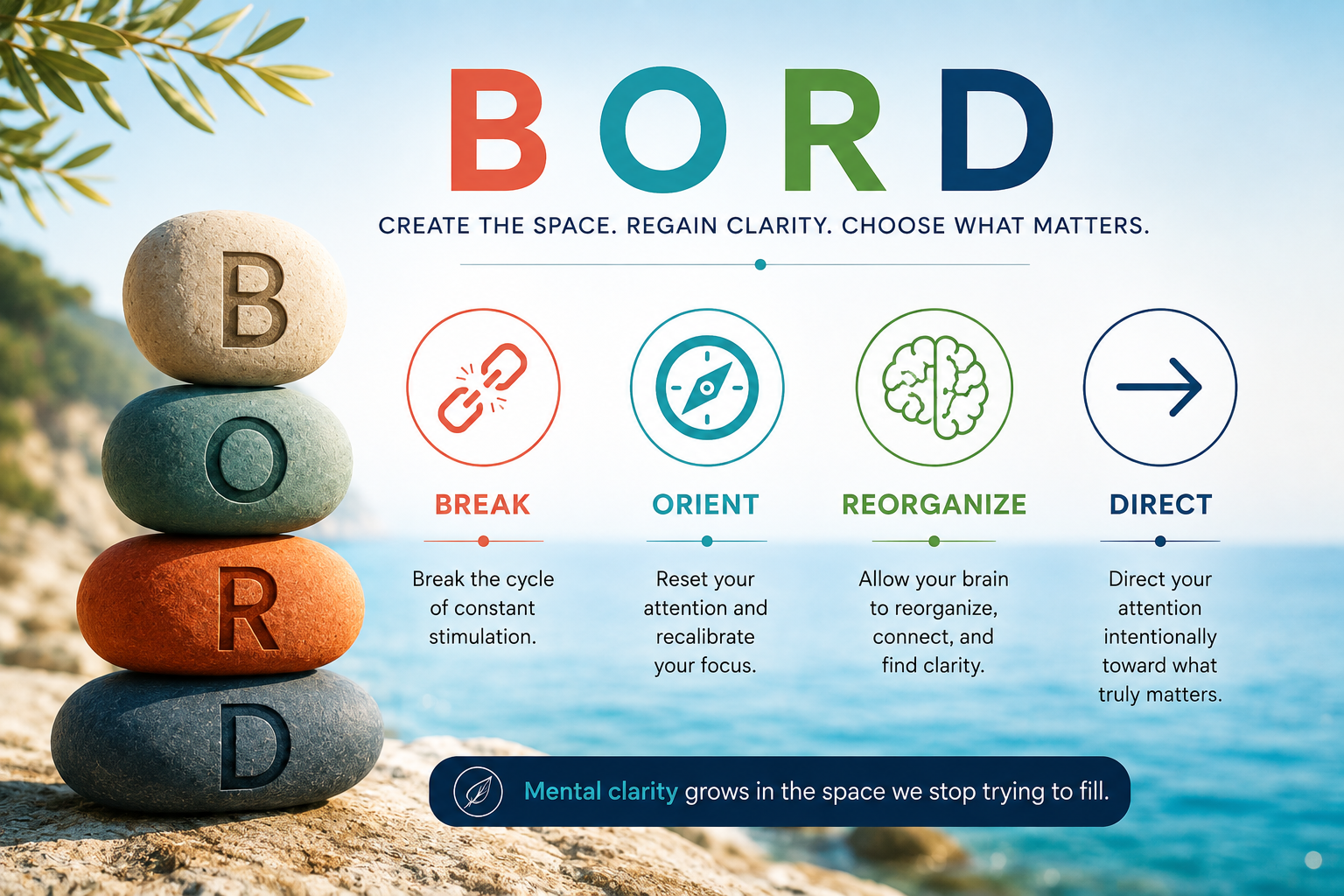
B – Break
Break the cycle of constant stimulation.
Your brain is constantly asking one question: What deserves my attention right now? A collection of interconnected regions known as the salience network helps answer that question by scanning both the outside world and the internal state of your body for anything that might matter.
Thousands of years ago, that meant noticing movement in the bushes or an unfamiliar sound nearby. Today, the same system responds to emails, notifications, conversations, headlines, and countless digital interruptions. Every shift of attention asks the brain to pause what it was doing, evaluate something new, and update its expectations. One interruption isn’t a problem. Hundreds of them throughout the day leave very little room for deeper processing.
Most of us don’t consciously decide to pick up our phone. Our hand is already moving before we fully notice it. The brain has learned that every swipe, notification, or refresh might reveal something useful, interesting, or rewarding. Dopamine supports this curiosity by increasing our motivation to seek information and reduce uncertainty. The reward isn’t only what we find. It’s also the possibility that something valuable might appear next. Over time, the brain learns to repeat this behaviour long before we make a conscious decision.
Creating a break doesn’t stop the brain from working. It simply reduces the number of competing demands placed on attentional systems. As external stimulation decreases, communication between large-scale brain networks becomes more flexible. The brain has more opportunity to strengthen memories, recognize patterns, and refine its map of the world.
Micro-practice: Finish one task before checking your phone or opening another tab.
Expected friction: Checking your phone will probably feel like the next obvious step. Pause for a moment. Giving the urge time to pass is part of creating the conditions your brain needs to think more clearly.
Benefit: A short pause gives the brain time to transform information into understanding instead of immediately chasing the next piece of information.
O – Orient
Orient your attention.
Have you ever reread an email and suddenly noticed a sentence you somehow missed the first time? Or searched for your keys while they were sitting in plain sight? The brain doesn’t simply observe reality. It continuously predicts it. Every experience, memory, emotion, and expectation shapes what we notice before we’re even aware of it. Incoming sensory information is constantly compared with those predictions, allowing the brain to respond quickly in a complex world.
When we’re stressed, mentally overloaded, or surrounded by constant stimulation, attention becomes increasingly selective. We begin noticing what confirms our expectations while overlooking information that might challenge them. The world hasn’t changed, but the brain is sampling less of it.
Orienting your attention introduces fresh evidence into that process. Looking away from the screen, noticing sounds, movement, light, physical sensations, or simply observing your own thoughts gives the brain new information to update its map of the world. The more accurately the brain understands what’s happening, the more flexible and adaptive its decisions become.
Micro-practice: Before opening your inbox, spend thirty seconds looking out of the window and notice five things you hadn’t paid attention to before.
Expected friction: It may feel as though nothing useful is happening. In reality, the brain has simply begun doing a different kind of work.
Benefit: A broader awareness makes it easier to recognize what genuinely deserves your attention and what is simply competing for it.
R – Reorganize
Allow your brain to reorganize.
Receiving information is only the beginning of learning. Understanding develops afterwards as the brain gradually integrates new experiences with existing knowledge. You’ve probably experienced it yourself. You stop thinking about a problem, step into the shower, go for a walk, or drive home, and the answer suddenly appears. It can feel as though your brain solved the problem out of nowhere. In reality, it never stopped working.
While your attention shifted elsewhere, the hippocampus and several large-scale brain networks continued integrating recent experiences with existing knowledge, strengthening useful connections, identifying patterns, and refining the brain’s map of the world. As external stimulation decreases, more resources become available for this internal work. The brain compares recent experiences with previous knowledge and gradually reorganizes scattered pieces of information into something that makes more sense.
The brain isn’t searching for more information. It’s searching for better explanations. That’s why moments of apparent inactivity often become moments of insight. Understanding doesn’t suddenly appear. It develops as the brain quietly continues making connections that weren’t obvious while attention was occupied elsewhere.
Micro-practice: Walk to your next meeting without listening to music, podcasts, or checking your phone.
Expected friction: It may feel unproductive because you’re not actively doing anything. The brain, however, is actively integrating information, recognizing patterns, and updating your map of the world.
Benefit: Reorganization transforms experience into understanding. It strengthens learning, supports creativity, improves problem-solving, and expands the possibilities you’re able to perceive.
D – Direct
Direct your attention intentionally.
Imagine you’ve just finished an important piece of work. Your phone vibrates, a new email arrives, you remember another task, and someone starts talking to you. Every one of those signals competes for your attention. Left on autopilot, the brain naturally follows whatever feels newest, loudest, or most emotionally significant.
The prefrontal cortex, together with executive control networks, helps interrupt that automatic response. These systems support planning, working memory, inhibitory control, and goal-directed behaviour, allowing you to pause, evaluate competing priorities, and intentionally decide where your attention belongs.
After creating space to process experiences and reorganize information, the executive system has a stronger foundation for decision-making. Attention becomes guided less by the loudest distraction and more by your goals, values, and long-term priorities. Every intentional decision further refines the brain’s map of the world, making future decisions clearer and more consistent.
Micro-practice: Before replying to an important email or message, pause and ask yourself, What deserves my attention most right now?
Expected friction: Reacting immediately will almost always feel easier because the brain naturally relies on familiar, low-effort patterns. Give yourself a moment before deciding whether the immediate reaction or the intentional choice truly deserves your attention.
Benefit: Repeated intentional choices strengthen self-regulation and gradually make clarity feel more natural than constant reaction.
Why BORD Creates Mental Clarity
We often assume clarity comes from thinking harder or collecting more information. The brain works differently. It needs opportunities to alternate between engaging with the world and making sense of what it has already experienced. Quiet moments allow attentional, executive, and internally directed brain networks to work together. Memories become more coherent, patterns become easier to recognize, perspective expands, and better decisions become easier to make.
Boredom simply creates the conditions. The brain creates understanding. Understanding expands perspective. Perspective supports intentional action. Mental clarity grows in the space we choose not to fill.
Author Ivana Song.
Where clarity becomes direction. Inspired by Song